

Organisation Information
XEWKIJA
2, Triq Torri Tingi, Xewkija, XWK 2231, Gozo
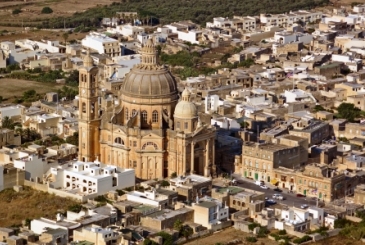
Xewkija lies in the middle between Mġarr Harbour and Victoria.
Xewkija is dominated by a huge rotunda church completed in 1971 after some 20 years building. It is Gozo’s answer to the Mosta Rotunda in Malta, and it was built in similar fashion, over an earlier, 17th century church which was only demolished at the last. The dome is larger than St. Paul’s Cathedral in London. The church has capacity for a congregation of 3000, the entire population of Xewkija. It was funded entirely by local donation and built mainly with labour from the village. The interior is stark and plain in comparison to the Islands’ usual baroque decoration, but is spectacular for its cavernous size. A small museum houses relics and paintings from the earlier church. The village has ancient roots despite its modern image. It was the first parish outside the capital and according to legend the first place on Gozo to convert to Christianity. The area was settled by the Arabs. A remnant of Arab culture in the whereabouts of Xewkija is the renowned marble slab of Majmuna (pron. Maimoona) with an inscription in Arabic dating back to 1173. The slab is the tombstone of an Arab girl named Majmuna, who died and was buried in the area between Xewkija and Sannat. Today the Majmuna Stone is one of the most highly cherished historical treasures in our islands and could be found in the Museum of Archaeology in Victoria. The Arab influence lasted well into the time of the Knights – several balconies on 17th century houses are in the richly-carved Moorish style.
The landscape around Xewkija has evidence of earlier times. The deep, scenic gorge, known as Mġarr ix-Xini, was cut by a prehistoric river. This natural landmark leads to a small inlet which was used by the Knights as a galley harbour. They built a tower on the headland to defend their base. Today, Mġarr ix-Xini is relatively quiet bathing spot with a small, shingle beach.
Contact Information
- Contact: Xewkija Local Council
- Phone: +356 21558822
- Phone: +356 21558866
- Fax: +356 21565719
- Email: [email protected]
- Website: http://www.xewkija.gov.mt
Facilities & Services
-
 Countryside Location
 -
 Disabled Facilities
 -
 Disabled Parking
 -
 Garden
 -
 Parking
 -
 Public Payphone
 -
 Public Toilets
 -
 Restaurant
 -
 WiFi
WiFi